Wednesday, 28 April 2010

Pele - World Cup Football Legends


Edison Arantes do Nascimento, KBE (born 23 October 1940), best known by his nickname Pelé (Brazilian Portuguese pronunciation: [peˈlɛ], usual English pronunciation: /ˈpɛleɪ/) is a retired Brazilian football player. While his birth certificate shows his first name as Edison, it is as Pelé that he has become a sporting legend. He is widely regarded by polls among football experts, former players and fans as the greatest footballer of all time.


In his native Brazil, Pelé is hailed as a national hero. He is known for his accomplishments and contributions to the game of football in addition to being officially declared football ambassador of the world by FIFA and a national treasure by the Brazilian government. He is also acknowledged for his vocal support of policies to improve the social conditions of the poor (when he scored his 1,000th goal he dedicated it to the poor children of Brazil). During his career, he became known as "The King of Football" (O Rei do Futebol), "The King Pelé" (O Rei Pelé) or simply "The King" (O Rei).

 
Pele - World Cup Soccer Legend

Spotted by football star Waldemar de Brito, Pelé began playing for Santos at 15 and his national team at 16, and won his first World Cup at 17. Despite numerous offers from European clubs, the economic conditions and Brazilian football regulations at the time benefited Santos, thus enabling them to keep Pelé for almost two decades until 1974. Pelé played as an inside forward, striker, and what later became known as the playmaker position. Pelé's technique and natural athleticism have been universally praised and during his playing years he was renowned for his excellent dribbling and passing, his pace, powerful shot, exceptional heading ability, and prolific goalscoring. He is the all-time leading scorer of the Brazil national football team and is the only footballer to be a part of three World Cup-winning squads. In 1962 he was on the Brazilian squad at the start of the World Cup but because of an injury suffered in the second match, he wasn't able to play the remainder of the tournament. In November 2007 FIFA announced that he would be awarded the 1962 medal retroactively, making him the only player in the world to have three World Cup winning medals.
Since his retirement in 1977, Pelé has been a worldwide ambassador for football and has undertaken various acting roles and commercial ventures.


 Early Years

Pelé was born in Três Corações, Brazil, the son of a Fluminense footballer Dondinho (born João Ramos do Nascimento) and Maria Celeste Arantes. He was named after the American inventor Thomas Edison,[16] however his parents decided to remove the 'i' and call him 'Edson'. But there was a mistake on the birth certificate, leading many documents to show his name as 'Edison', not 'Edson', as he is actually called. He was originally nicknamed Dico by his family. He did not receive the nickname "Pelé" until his school days, when it is claimed he was given it because of his pronunciation of the name of his favorite player, local Vasco da Gama goalkeeper Bilé, which he misspoke but the more he complained the more it stuck. In his autobiography, Pelé stated he had no idea what the name means, nor did his old friends. Apart from the assertion that the name is derived from that of Bilé, the word has no known meaning, although it is the name of a Hawaiian volcano goddess and it does resemble the Irish language word peile, meaning football.


Pele grew up in poverty in Bauru, São Paulo. He earned extra money by working in tea shops as a servant. Taught to play by his coach, he could not afford a proper football and usually played with either a sock stuffed with newspaper, tied with a string or a grapefruit. In 1954, several members of the Ameriquinha team, including Pelé, were invited to join the Baquinho boys' team to be managed by former Brazilian international Waldemar de Brito, who played in the 1934 World Cup in Italy. At the age of fifteen, he joined the Santos FC junior team. He played for one season before joining the senior team

National Team Career      

Pelé's first international match was a 2–1 defeat against Argentina on 7 July 1957. In that match, he scored his first goal for Brazil aged 16 years and 9 months to become the youngest player to score in International football.

1958 World Cup

His first match in the World Cup was against USSR in the first round of the 1958 FIFA World Cup. He was the youngest player of that tournament, and at the time the youngest ever to play in the World Cup. He scored his first World Cup goal against Wales in quarterfinals, the only goal of the match, to help Brazil advance to semifinals, while becoming the youngest ever World Cup goalscorer at 17 years and 239 days. Against France in the semifinal, Brazil was leading 2–1 at halftime, and then Pelé scored a hat-trick, becoming the youngest in World Cup history to do so.

On 19 June 1958 Pelé became the youngest player to play in a World Cup final match at 17 years and 249 days. He scored two goals in the final as Brazil beat Sweden 5–2. His first goal, a lob over a defender followed by a precise volley shot, was selected as one of the best goals in the history of the World Cup. When the match ended, he passed out on the field, and had to be attended by the medical staff. He then recovered, and was visibly compelled by the victory, in tears as being congratulated by his teammates. He finished the tournament with six goals in four matches played, tied for second place, behind record-breaker Just Fontaine.


1962 World Cup

In the first match of the 1962 World Cup, against Mexico, Pelé assisted on the first goal and then scored the second one to go up 2–0 after a run past four defenders. He injured himself while attempting a long-range shot against Czechoslovakia. This would keep him out of the rest of the tournament, and forced coach Aymoré Moreira to make his only lineup change of the tournament. The substitute was Amarildo, who performed well for the rest of the tournament. Yet it was Garrincha who would take the leading role and carry Brazil to their second World Cup title.

1966 World Cup

The 1966 World Cup was marked among other things for its brutal fouling on Pelé by the Bulgarian and Portuguese defenders. Brazil was eliminated in the first round, playing only three matches. Pelé scored the first goal from a free kick against Bulgaria, but due to his injury, a result of persistent fouling by the Bulgarians, he was left out for the second game against Hungary. Brazil lost that game and Pelé, although still recovering was brought back for the last crucial match against Portugal. In that game João Morais brutally fouled Pelé, but was allowed to stay on field by referee George McCabe. Pelé had to stay in the field limping for the rest of the game, since substitutes were not allowed at that time. After this game he vowed he would not play again in the World Cup, a decision he would later change.

 1970 World Cup

When Pelé was called to the national team in early 1969, he first refused, but then accepted and played in six World Cup qualifying matches, scoring six goals. The 1970 tournament in Mexico was to be Pelé's last. Brazil's squad for the tournament featured major changes in relation to the 1966 squad. Players like Garrincha, Nilton Santos, Djalma Santos, and Gilmar had already retired, but the team, with Pelé, Rivelino, Jairzinho, Gérson, Tostão, and Clodoaldo, is widely considered one of the greatest football teams ever.


In the first match, against Czechoslovakia, Pelé gave Brazil a 2–1 lead after controlling Gerson's long pass with his chest. In this match, Pelé audaciously attempted to lob goalkeeper Ivo Victor from the half-way line, only narrowly missing the Czech goal. Brazil went on to win the match, 4–1. In the first half of the match against England, he nearly scored with a header that was spectacularly saved by Gordon Banks. In the second half, he assisted Jairzinho for the only goal of the match. Against Romania, he opened the score on a direct free kick goal, a strong strike with the outside of his right foot. Later on the match he scored again to put the score 3–1. Brazil won by a final score of 3–2. In quarterfinals against Peru, Brazil won 4–2, with Pelé assisting Tostão on his team's third goal. In the semi-finals, Brazil faced Uruguay for the first time since the 1950 World Cup final round match. Jairzinho put Brazil ahead 2–1, and Pelé assisted Rivelino for the 3–1. During that match, Pelé made one of his most famous plays. Tostão gave Pelé a through ball, and Uruguay's goalkeeper Ladislao Mazurkiewicz took notice of it. The keeper ran off of his line to get the ball before Pelé, but Pelé got there first, and without touching the ball, he caused it to go past the keeper, to the latter's left, while Pelé went right. Pelé went around the goalkeeper and took a shot while turning towards the goal, but he turned in excess as he shot, and the ball drifted just wide of the far post.

Brazil played Italy in the final, with Pelé scoring the opener on a header over defender Tarcisio Burgnich. He then made assists on Jairzinho's and Carlos Alberto's goals, the latter one after an impressive collective play. Brazil won the match 4–1, keeping the Jules Rimet Trophy indefinitely. Burgnich, who marked Pelé during the match, was quoted saying "I told myself before the game, he's made of skin and bones just like everyone else — but I was wrong".


Pelé's last international match was on 18 July 1971 against Yugoslavia in Rio de Janeiro. With Pelé on the field, the Brazilian team's record was 67 wins, 14 draws, and 11 losses, and went on to win three World Cups. Brazil never lost a match while fielding both Pelé and Garrincha.

South American Championship

Pelé also played in the South American Championship. In the 1959 competition he was top scorer with eight goals, as Brazil came second in the tournament.

World Cup Football Final 1930 - Videos


 World Cup Football Final 1930 - Watch Video Clips Here


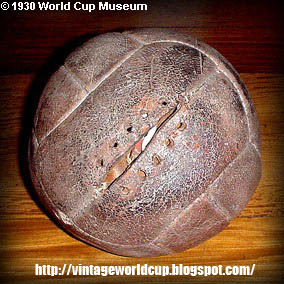
The resounding wins for Uruguay and Argentina in the semi-finals meant the final was a repeat of the matchup in the 1928 Olympic final, which Uruguay won 2–1 after a replay. The final was played at the Estadio Centenario on 30 July. Feelings ran high around the La Plata Basin, dispelling any uncertainty as to whether the tournament had captured the imagination of the public. The ten boats earmarked to carry Argentine fans from Buenos Aires to Montevideo proved inadequate, and any number of assorted craft attempted the crossing. An estimated 10–15,000 Argentinians made the trip, but the port at Montevideo was so overwhelmed that many did not even make landfall before kick-off, let alone reach the stadium. At the stadium, supporters were searched for weapons. The gates were opened at eight o'clock, six hours before kick-off, and at noon the ground was full, the official attendance 93,000. A disagreement overshadowed the build-up to the match as the teams failed to agree on who should provide the match ball, forcing FIFA to intervene and decree that the Argentine team would provide the ball for the first half and the Uruguayans would provide their own for the second. Uruguay made one change from their semi-final lineup. Castro replaced Anselmo, who missed out due to illness. Monti played for Argentina despite receiving death threats on the eve of the match. The referee was Belgian Jean Langenus, who only agreed to officiate a few hours before the game, having sought assurances for his safety. One of his requests was for a boat to be ready at the harbour within one hour of the final whistle, in case he needed to make a quick escape.


The hosts scored the opening goal through Pablo Dorado, a low shot from a position on the right. Argentina, displaying superior passing ability, responded strongly. Within eight minutes they were back on level terms. Carlos Peucelle received a Ferreira through-ball, beat his marker and equalised. Shortly before half-time leading tournament goalscorer Guillermo Stábile gave Argentina a 2–1 lead. Uruguay captain Nasazzi protested, maintaining that Stábile was offside, but to no avail. In the second half Uruguay gradually became ascendant. Shortly after Monti missed a chance to make the score 3–1, Uruguay attacked in numbers, and Pedro Cea scored an equaliser. Ten minutes later a goal by Santos Iriarte gave Uruguay the lead, and just before full-time Castro made it 4–2 to seal the win. Langenus ended the match a minute later, and Uruguay thus added the title World Cup winners to their mantle of Olympic champions. Jules Rimet presented the World Cup Trophy, which was later named for him, to the head of the Uruguayan Football Association, Raúl Jude. The following day was declared a national holiday in Uruguay; in the Argentinian capital, Buenos Aires, a mob threw stones at the Uruguayan consulate. Only one player from the final, Francisco Varallo (who played as a forward for Argentina), is still alive as of 2010. France, Yugoslavia and the United States all undertook friendlies in South America following the competition. Brazil played France on 1 August, Yugoslavia on 10 August and the United States on 17 August, while Argentina hosted Yugoslavia on 3 August.


Football World Cup Tournament Results 1930


Pool One

13.07.1930    France 4 - 1 Mexico
15.07.1930    Argentina 1 - 0 France
16.07.1930    Chile 3 - 0 Mexico
19.07.1930    Chile 1 - 0 France
19.07.1930    Argentina 6 - 3 Mexico
22.07.1930    Argentina 3 - 1 Chile

*Argentina Wins Group - Through to Next Round

Pool Two

14.07.1930    Yugoslavia 2 - 1 Brazil
17.07.1930    Yugoslavia 4 - 0 Bolivia
20.07.1930    Brazil 4 - 0 Bolivia

*Yugoslavia Wins Group - Through to Next Round

Pool Three

14.07.1930    Romania 3 - 1 Peru
18.07.1930    Uruguay 1 - 0 Peru
21.07.1930    Uruguay 4 - 0 Romania
*Uruguay Wins Group - Through to Next Round
Pool 4

13.07.1930    USA 3 - 0 Belgium 
17.07.1930    USA 3 - 0 Paraguay
20.07.1930    Paraguay 1 - 0 Belgium

*USA Wins Group - Through to Next Round

Semi-finals

26.07.1930    Argentina 6 - 1 USA
27.07.1930    Uruguay 6 - 1 Yugoslavia

World Cup Final 1930

 
30.07.1930    Uruguay 4 - 2 Argentina

Uruguay World Cup Tournament 1930 - Part 2


 Uruguay World Cup 1930 Tournament Summary

 The thirteen teams were drawn into four groups, and all the games were played in the Uruguayan capital, Montevideo. Uruguay, Argentina, Brazil and the USA were seeded, and were kept apart in the draw, which took place in Montevideo once all the teams arrived. Since there were no qualifying games, the opening two matches of the tournament were the first World Cup games ever played, taking place simultaneously on 13 July 1930; France beat Mexico 4–1 at the Estadio Pocitos, while the United States defeated Belgium 3–0 at the same time at the Estadio Gran Parque Central. France's Lucien Laurent was the scorer of the first World Cup goal

Group 1

The first group was the only one to contain four teams: Argentina, Chile, France and Mexico. Two days after France's victory over Mexico, they faced group favourites Argentina. Injuries hindered France; goalkeeper Thépot had to leave the field after 20 minutes, and Laurent, after a fierce tackle by Luis Monti, spent most of the match limping. However, they held out for most of the match, only succumbing to an 81st-minute goal scored from a Monti free kick. The game featured an officiating controversy when referee Almeida Rego erroneously blew the final whistle six minutes early, with Frenchman Marcel Langiller clear on goal; play only resumed after protests from the French players. Though France had played twice in 48 hours, Chile had yet to play their first match. They faced Mexico the following day, gaining a comfortable 3–0 win.


Argentina's second match, against Mexico, featured the first penalty of the tournament. A total of five penalties, three of them controversial, were awarded during the match, which was refereed by the Bolivian coach Ulises Saucedo. Guillermo Stábile scored a hat-trick on his international debut as Argentina won 6–3, despite the absence of their captain Manuel Ferreira, who had returned to Buenos Aires to take a law exam. Qualification was decided by the group's final match, contested by Argentina and Chile, who had beaten France and Mexico respectively. The game was marred by a brawl sparked by a foul on Arturo Torres by Monti. Argentina won 3–1 against their neighbours and progressed to the semi-finals.
 

Group 2

The second group contained Brazil, Bolivia and Yugoslavia. Brazil, the group seeds, were expected to progress. However, in the group's opening match Yugoslavia gained an unexpected 2–1 victory over Brazil. Going into the tournament Bolivia had never previously won an international match. For their opener they paid tribute to the hosts by wearing shirts each emblazoned with a single letter, spelling "Viva Uruguay" as the team lined up. Both of Bolivia's matches followed a similar pattern, a promising start gradually transforming into heavy defeat. Against Yugoslavia, they held out for an hour before conceding, but were four goals down by the final whistle. Misfortune played its part; several Bolivian goals were disallowed. Against Brazil, when both teams had only pride to play for, the score was 1–0 to Brazil at half-time. Brazil added three more in the second half, two of them scored by the multi-sportsman Preguinho. Yugoslavia qualified for the semi-finals.


Group 3

Hosts Uruguay were in a group with Peru and Romania. The opening match in this group saw the first sending off in the competition, when Plácido Galindo of Peru was dismissed against Romania. The Romanians made their man advantage pay; their 3–1 win included two late goals. This match had the smallest crowd of any in World Cup history. The official attendance was 2,459, but the actual figure is generally accepted to be around 300.


Due to construction delays at Estadio Centenario, Uruguay's first match was not played until five days into the tournament. The first to be held at the Centenario, it was preceded by a ceremony in honour of the Uruguayan centenary celebrations. The Uruguayan team spent the four weeks preceding the match in a training camp, at which strict discipline was exercised. Goalkeeper Andrés Mazali was dropped from the squad for breaking a curfew to visit his wife. One hundred years to the day of the creation of Uruguay's first constitution, the hosts won a tight match against Peru 1–0. The result was viewed as a poor performance by the Uruguayan press, but lauded in Peru. Uruguay subsequently defeated Romania with ease, scoring four first half goals to win 4–0.

  
Group 4

The United States dominated the fourth group. The USA team, which contained a significant number of new caps, were reputedly nicknamed "the shot-putters" by an unnamed source in the French contingent. They beat their first opponents, Belgium, 3–0. The ease of the victory was unexpected; Uruguayan newspaper Imparcial wrote that "the large score of the American victory has really surprised the experts". Belgian reports bemoaned the state of the pitch and refereeing decisions, claiming that the second goal was offside. The group's second match, played in windy conditions, witnessed the first tournament hat-trick, scored by Bert Patenaude of the United States against Paraguay. Until 10 November 2006 the first hat-trick that FIFA acknowledged had been scored by Guillermo Stábile of Argentina, two days after Patenaude; however, in 2006 FIFA announced that Patenaude's claim to being the first hat-trick scorer was valid, as a goal previously assigned to teammate Tom Florie's was reattributed to Patenaude. With the USA having secured qualification, the final match in the group was a dead rubber. Paraguay beat Belgium by a 1–0 margin.


Semi-finals

The four group winners, Argentina, Yugoslavia, Uruguay, and the United States, moved to the semi-finals. The two semi-final matches saw identical scores. In the first semi-final, a Monti goal half-way through the first half gave Argentina a 1–0 half-time lead against the United States. In the second half the strength of the United States team was overwhelmed by the pace of the Argentinian attacks, the match finishing 6–1 to Argentina.


In the second semi-final there were shades of the 1924 Summer Olympics match between Yugoslavia and Uruguay. Here, though, Yugoslavia took a surprise lead through Sekulić. Uruguay then took a 2–1 lead, but shortly before half-time Yugoslavia had a goal disallowed due to a controversial offside decision. The hosts scored four more in the second half to win 6–1, Pedro Cea completing a hat-trick.


Third and fourth place

The now-traditional third place playoff was not established until 1934, so the 1930 World Cup is unique in having no match take place between the semi-finals and the final. Occasional sources, notably a FIFA Bulletin from 1984, incorrectly imply that a third-place match occurred and was won 3–1 by Yugoslavia. Accounts differ as a whether a third-place was originally scheduled. According to a 2009 book by Hyder Jawad, Yugoslavia refused to play a third-place match because they were upset with the refereeing in their semi-final against Uruguay. A FIFA technical committee report on the 1986 World Cup included full rankings of all teams at all previous World Cup finals; this report retrospectively ranked the United States third and Yugoslavia fourth, a practice since continued by FIFA.


Final

The resounding wins for Uruguay and Argentina in the semi-finals meant the final was a repeat of the matchup in the 1928 Olympic final, which Uruguay won 2–1 after a replay. The final was played at the Estadio Centenario on 30 July. Feelings ran high around the La Plata Basin, dispelling any uncertainty as to whether the tournament had captured the imagination of the public. The ten boats earmarked to carry Argentine fans from Buenos Aires to Montevideo proved inadequate, and any number of assorted craft attempted the crossing. An estimated 10–15,000 Argentinians made the trip, but the port at Montevideo was so overwhelmed that many did not even make landfall before kick-off, let alone reach the stadium. At the stadium, supporters were searched for weapons. The gates were opened at eight o'clock, six hours before kick-off, and at noon the ground was full, the official attendance 93,000. A disagreement overshadowed the build-up to the match as the teams failed to agree on who should provide the match ball, forcing FIFA to intervene and decree that the Argentine team would provide the ball for the first half and the Uruguayans would provide their own for the second. Uruguay made one change from their semi-final lineup. Castro replaced Anselmo, who missed out due to illness. Monti played for Argentina despite receiving death threats on the eve of the match. The referee was Belgian Jean Langenus, who only agreed to officiate a few hours before the game, having sought assurances for his safety. One of his requests was for a boat to be ready at the harbour within one hour of the final whistle, in case he needed to make a quick escape.


The hosts scored the opening goal through Pablo Dorado, a low shot from a position on the right. Argentina, displaying superior passing ability, responded strongly. Within eight minutes they were back on level terms. Carlos Peucelle received a Ferreira through-ball, beat his marker and equalised. Shortly before half-time leading tournament goalscorer Guillermo Stábile gave Argentina a 2–1 lead. Uruguay captain Nasazzi protested, maintaining that Stábile was offside, but to no avail. In the second half Uruguay gradually became ascendant. Shortly after Monti missed a chance to make the score 3–1, Uruguay attacked in numbers, and Pedro Cea scored an equaliser. Ten minutes later a goal by Santos Iriarte gave Uruguay the lead, and just before full-time Castro made it 4–2 to seal the win. Langenus ended the match a minute later, and Uruguay thus added the title World Cup winners to their mantle of Olympic champions. Jules Rimet presented the World Cup Trophy, which was later named for him, to the head of the Uruguayan Football Association, Raúl Jude. The following day was declared a national holiday in Uruguay; in the Argentinian capital, Buenos Aires, a mob threw stones at the Uruguayan consulate. Only one player from the final, Francisco Varallo (who played as a forward for Argentina), is still alive as of 2010. France, Yugoslavia and the United States all undertook friendlies in South America following the competition. Brazil played France on 1 August, Yugoslavia on 10 August and the United States on 17 August, while Argentina hosted Yugoslavia on 3 August.

Venues 

All matches took place in Montevideo. Three stadiums were used: Estadio Centenario, Estadio Pocitos, and Estadio Parque Central. The 100,000 capacity Estadio Centenario was built both for the tournament and as a celebration of the centenary of Uruguayan independence. Designed by Juan Scasso, it was the primary stadium for the tournament, referred to by Rimet as a "temple of football". The stadium hosted 10 of the 18 matches including both semi-finals and the final. However, a rushed construction schedule and delays caused by the rainy season meant the Centenario was not ready for use until five days into the tournament. Early matches were played at smaller stadiums usually used by Montevideo football clubs Nacional and Peñarol, the 20,000 capacity Parque Central and the Pocitos.


SEE: Uruguay World Cup Tournament 1930 - Part 3

Uruguay World Cup Tournament 1930 - Part 1


The 1930 FIFA World Cup was the inaugural edition of the world championship for international association football teams – the FIFA World Cup. It was played in Uruguay from 13 July to 30 July. Fédération Internationale de Football Association (FIFA) selected Uruguay as host nation as the country would be celebrating the centenary of its independence, and the Uruguay national football team had successfully retained their football title at the 1928 Summer Olympics. All matches were played in the Uruguayan capital, Montevideo, the majority at the Estadio Centenario, which was built for the tournament.


Thirteen teams, seven from South America, four from Europe and two from North America entered the tournament. Few European teams chose to participate due to the duration and cost of travel. The teams were divided into four groups, with the winner of each group progressing to the semi-finals. The first two World Cup matches took place simultaneously, and were won by France and the USA, who defeated Mexico 4–1 and Belgium 3–0, respectively. Lucien Laurent of France scored the first goal in World Cup history.

Argentina, Uruguay, the USA and Yugoslavia each won their respective groups to qualify for the semi-finals. In the final, hosts and pre-tournament favourites Uruguay defeated Argentina 4–2 in front of a crowd of 93,000 people, and became the first nation to win a World Cup.


Origins

In 1914, FIFA agreed to recognise the Olympic football tournament as a "world football championship for amateurs", and took responsibility for managing the event at the next three Olympiads: from 1920 to 1928. In the 1908 Olympic Games and the 1912 Olympic Games the football competitions had been organised by The Football Association and the Swedish Football Association respectively. The preliminary schedule for the 1932 Summer Olympics, held in Los Angeles did not include football. FIFA and the International Olympic Committee disagreed over the status of amateur players, so football was dropped from the Games. On 26 May 1928, at FIFA's Amsterdam conference and on the opening day of the Olympic football tournament, FIFA president Jules Rimet announced plans to stage a tournament independent of the Olympics, open to all FIFA members and with professionalism permitted. The membership voted 25–5 to accept the proposal. Italy, Sweden, the Netherlands, Spain and Uruguay all lodged applications to host the event. Uruguay's bid became the clear favourite for a number of reasons. Uruguay were reigning Olympic champions, and thus de facto world champions, the bid included plans to build a new stadium as a centrepiece, and the Uruguayan authorities also offered to refund the expenses of all participants. The other nations withdrew their bids, and Uruguay was chosen to host the tournament.


 Squads

The first World Cup was the only one without qualification. Every country affiliated with FIFA was invited to compete, and given a deadline of 28 February 1930 to accept. Plenty of interest was shown by nations in the Americas; Argentina, Brazil, Bolivia, Chile, Mexico, Paraguay, Peru and the United States all entered. However, due to the long and costly trip across the Atlantic Ocean, and the length of absence required for players, very few European teams were inclined to take part. Some refused to countenance travel to South America in any circumstances, and no European entries were received before the February deadline. In an attempt to gain some European participation, the Uruguayan Football Association sent a letter of invitation to The Football Association, even though the Home Nations were not members of FIFA at the time. This was rejected by the FA Committee on 18 November 1929. Two months before the start of the tournament, no team from Europe had officially entered.


FIFA president Rimet intervened, and eventually four European teams made the trip by sea: Belgium, France, Romania, and Yugoslavia. The Romanians, managed by Costel Radulescu and coached by their captain Rudolf Wetzer and Octav Luchide, entered the competition following the intervention of newly crowned King Carol II. He selected the squad personally, and negotiated with employers to ensure that the players would still have jobs upon their return. The Romanians boarded the SS Conte Verde at Genoa, the French were picked up at Villefranche-sur-Mer on 21 June 1930; and the Belgians embarked at Barcelona. The Conte Verde carried Rimet, the trophy and the three designated European referees: the Belgians Jean Langenus and Henri Christophe, along with Thomas Balway, a Parisien who may have been English. The Brazilian team were picked up when the boat docked in Rio de Janeiro on 29 June before arriving in Uruguay on 4 July. Yugoslavia traveled via the mail steamship Florida from Marseille.

World Cup Final

 The Uruguay v Argentina World Cup Final was televised live and can be viewed elsewhere in this blog...


SEE: Uruguay World Cup Tournament 1930 - Part 2